Views: 0 Author: Site Editor Publish Time: 2026-07-20 Origin: Site


Acquiring a Press Brake Machine represents a critical operational pivot. It dictates shop floor throughput, part accuracy, and scrap rates. Misaligning machine specifications with actual production demands carries severe risks. Under-sizing leads to equipment fatigue and premature failure. Over-sizing destroys your return on investment. Ignoring software and tooling compatibility creates severe operational bottlenecks that cripple daily output. This guide provides an evidence-based evaluation framework. We match technical machine capabilities with specific fabrication requirements. You will learn how to align tonnage, drive type, and CNC integration with your material realities, part geometries, and operator skill levels. By establishing a strict operational baseline, fabrication shops can select equipment that actively solves production challenges.
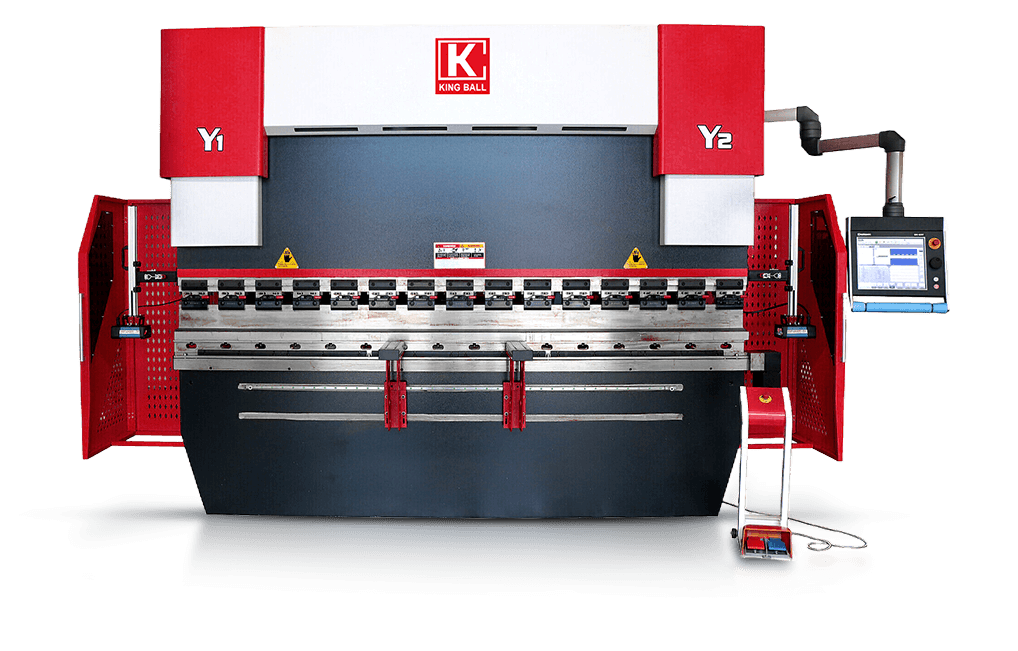
Tonnage and Length Dictate the Baseline: Accurate calculation of required bending force—factoring in material tensile strength, thickness, and bending method—is the non-negotiable starting point for machine selection.
Drive Technology Impacts Efficiency: The choice between hydraulic, electric, and hybrid press brake machines fundamentally alters energy consumption, cycle times, and maintenance overhead.
Software and Tooling Drive Throughput: Advanced CNC controllers, offline programming capabilities, and quick-change tooling systems are critical for mitigating the industry-wide shortage of skilled operators.
Deflection Compensation is Mandatory for Precision: Automated crowning systems are essential for maintaining consistent angles across long bending lengths, directly impacting part quality and reducing rework.
Table of Contents
Auditing the primary materials processed in your shop is the first step in equipment selection. Carbon steel, stainless steel, aluminum, and high-strength alloys behave differently under pressure. A Press Brake Machine must handle the toughest material you bend regularly. Varying tensile strengths and yield points directly influence the required bending force. Bending 1/4-inch stainless steel requires significantly more tonnage than bending 1/4-inch mild steel.
Material springback presents a physical reality on the shop floor. High-strength alloys and stainless steel exhibit significant springback. The punch must travel deeper into the V-die to overbend the material. This requires sufficient stroke length and daylight. Material thickness variations within standard gauge tolerances also affect bend angle consistency. Modern control systems with angle measurement sensors compensate for these variations in real-time. They ensure accurate bends despite inconsistent material batches from the mill.
Material Type | Average Tensile Strength (PSI) | Tonnage Multiplier (vs. Mild Steel) | Springback Severity |
|---|---|---|---|
Mild Steel (A36) | 58,000 - 80,000 | 1.0x | Low |
Stainless Steel (304) | 73,000 - 90,000 | 1.5x - 1.7x | High |
Aluminum (5052-H32) | 31,000 - 38,000 | 0.5x | Moderate |
High-Strength Steel (AR400) | 145,000 - 160,000 | 2.5x - 3.0x | Very High |
The maximum required bending length dictates the physical dimensions of the machine. You must distinguish between the overall bed length and the distance between the side housings. If a part requires a flange that exceeds the distance between the housings, it cannot bend deeply into the machine. Always size the machine so your longest standard parts fit comfortably within the side housings.
Part geometry heavily impacts machine selection. Open height (daylight), stroke length, and deep throat depth restrict or enable specific forming operations. Bending deep boxes, return flanges, and narrow channels requires significant daylight to remove the formed part from the tooling. A machine with limited stroke or shallow throat depth physically blocks complex geometries. This renders the equipment useless for those specific applications.
Define the precision requirements of your output before evaluating machine features. Structural brackets and heavy plate components often tolerate loose tolerances. This allows for standard machine configurations. High-precision angles required for medical, aerospace, or electronics applications demand strict adherence to tight tolerances.
High accuracy demands dictate the requirement for high-end positioning feedback systems. Linear encoders mounted independently from the side frames provide precise ram positioning data to the CNC. They compensate for frame deflection under load. Real-time angle measuring systems utilize lasers or mechanical sensors to adjust ram depth on the fly. They guarantee exact angles without manual test bends.
High-mix, low-volume environments require extreme flexibility. Shops processing dozens of different parts daily must prioritize rapid setup times. Multi-axis backgauges, quick-change tooling systems, and intuitive CNC interfaces minimize the downtime between different jobs. The goal is to keep the ram moving. You cannot afford to spend hours adjusting manual stops and changing heavy dies.
Low-mix, high-volume production focuses entirely on cycle speed and reliability. Automated batch processing, durability under continuous multi-shift operations, and robotic integration take precedence. The raw speed of the ram approach and return ensures maximum throughput. Robust mechanical components designed for continuous duty prevent breakdowns during massive production runs.
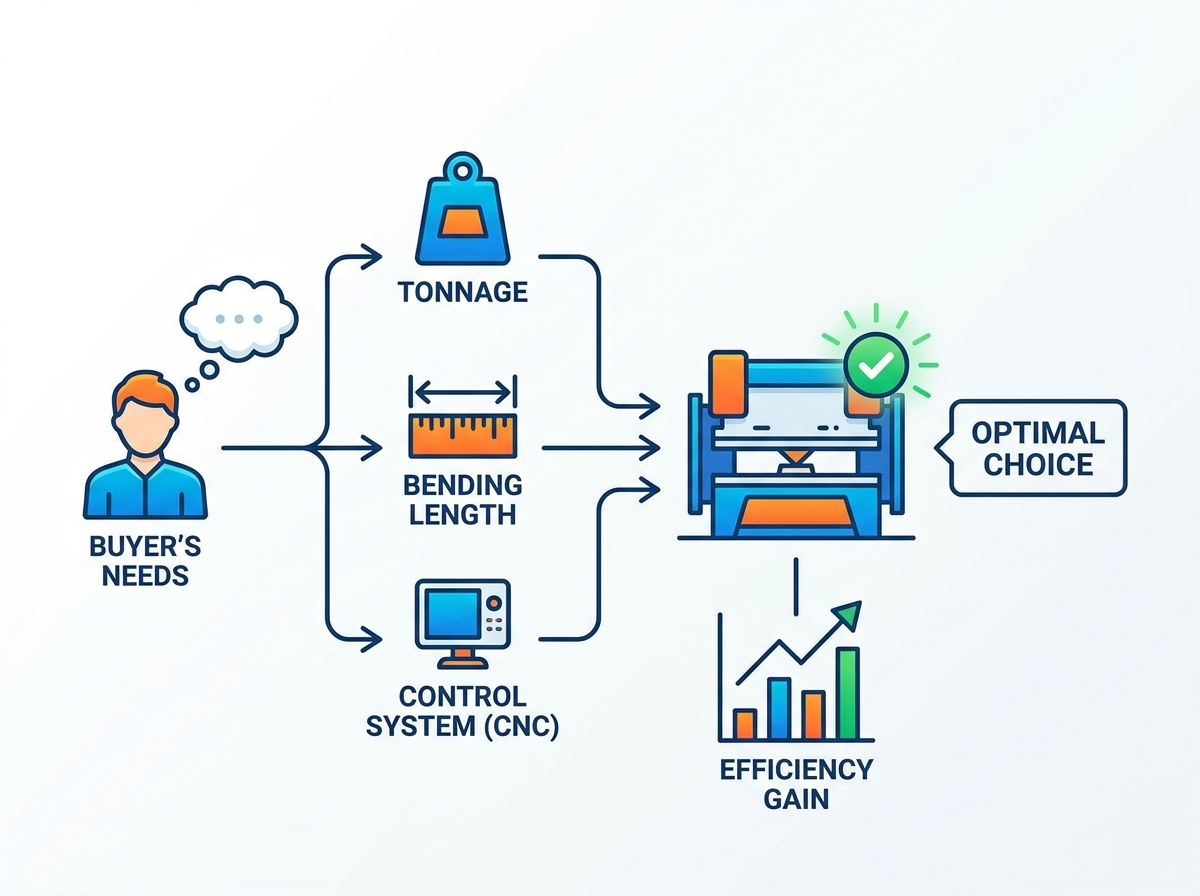
Calculating the required tonnage per inch or foot relies on material thickness, V-die opening, and material tensile strength. The standard industry framework assumes air bending mild steel. The critical relationship lies between the V-die opening and the resulting tonnage requirement. A standard V-die opening is typically eight times the material thickness for mild steel. A wider V-die reduces the required tonnage but increases the inside radius of the bend. A narrower V-die achieves a tighter radius but demands significantly more bending force.
To calculate baseline tonnage for mild steel, operators use standard force charts provided by tooling manufacturers. When bending materials other than mild steel, you apply a multiplier based on the material's tensile strength. Failing to calculate this correctly leads to severe tooling damage and machine overload.
The chosen bending method drastically impacts tonnage requirements. Air bending is the modern standard for CNC equipment. The punch pushes the material into the V-die without touching the bottom. It relies on precise ram depth to determine the angle. This method requires the least amount of tonnage. It allows multiple angles to be formed with the same tooling setup.
Bottoming and coining require significantly higher tonnage. Bottoming forces the material against the sides of the V-die. It requires roughly three times the tonnage of air bending. Coining stamps the punch tip completely into the material. It requires up to five times the tonnage. These older methods are rarely used on modern precision equipment due to the massive force requirements and specialized tooling needed.
Never purchase a machine where standard daily operations run at 100% of maximum capacity. Pushing equipment to its absolute limit causes severe hydraulic degradation. It leads to permanent frame deflection and premature mechanical failure. Always apply a standard safety margin of 20% to 30% above the maximum calculated required tonnage.
If your calculations determine a requirement of 100 tons for your thickest, longest part, specify a 130-ton machine. This buffer ensures the equipment operates comfortably within its design limits. It extends the lifespan of the hydraulic pumps, seals, and structural frame components. It also provides headroom for unexpected material variations.
Hydraulic systems represent the traditional standard for heavy-duty fabrication. They offer massive tonnage capacity and proven durability for thick plate bending. The initial capital outlay is generally lower than advanced electric models. This makes them accessible for general fabrication shops handling structural steel.
Hydraulic systems have distinct disadvantages. Energy consumption is high because the hydraulic pumps run continuously, even when the machine is idle. Ram speeds are generally slower compared to electric drives. Hydraulic fluid is susceptible to thermal expansion over long shifts. As the oil heats up, viscosity changes. This subtly affects ram positioning precision if the machine lacks advanced thermal compensation.
Electric drives utilize servo motors coupled with belts, pulleys, or high-precision ball screws to move the ram. These systems offer extreme precision and rapid acceleration and deceleration. They significantly reduce cycle times. Energy consumption is remarkably low because power is only consumed during actual ram movement.
Maintenance is minimal since there are no hydraulic pumps, valves, or oil to replace. Operation is exceptionally quiet. The primary limitation is capacity. Electric models are generally restricted to lower tonnage applications, typically under 300 tons, and shorter bed lengths. They require a higher upfront investment compared to standard hydraulic units.
Hybrid systems combine servo-driven motors with localized hydraulic blocks. They offer the high tonnage capabilities of traditional hydraulics alongside the energy efficiency, speed, and precision of electric models. The servo motor only drives the hydraulic pump when ram movement is required. This eliminates idle energy waste and reduces oil heating.
Hybrids provide an optimal balance of power and efficiency. They represent a middle-ground capital investment. The internal systems are complex, combining both electrical and hydraulic engineering. Servicing these machines requires specialized technician support familiar with hybrid drive architectures.
Drive Type | Best Application | Energy Efficiency | Maintenance Level |
|---|---|---|---|
Hydraulic | Heavy plate, structural steel, high tonnage | Low (Pumps run continuously) | High (Oil changes, filter replacements, valve checks) |
Electric | Precision sheet metal, high-speed production | High (Power on demand) | Low (No oil, fewer moving parts) |
Hybrid | Mixed production requiring both power and speed | High (Servo-driven hydraulics) | Medium (Complex internal systems) |

Offline programming software allows engineers to create, verify, and simulate bending sequences away from the machine. This shifts the programming burden from the shop floor to the office. It ensures the machine spends its time bending metal rather than waiting for an operator to input data. 3D collision detection is a critical feature of these software packages.
By simulating the entire bending process virtually, the software identifies potential collisions between the part, tooling, and machine frame before the first piece of metal is cut. This prevents costly tooling damage. It eliminates scrap parts and drastically reduces machine downtime during complex setups.
The fabrication industry faces a severe shortage of skilled operators. Modern CNC interfaces mitigate this risk through graphical, touchscreen controls. High-end controllers provide visual, step-by-step bending instructions directly on the screen.
Operators view 3D part orientations, showing exactly how to hold and flip the material for each sequence. Automatic sequence generation calculates the most efficient bending order and backgauge positions. These intuitive interfaces allow less experienced personnel to produce accurate parts safely. They reduce the reliance on veteran operators for daily production tasks.
Tooling selection directly impacts setup times and part quality. American style tooling is common but often requires manual alignment. European (Promecam) tooling offers a wide variety of profiles and is easily sourced. Wila/Trumpf (New Standard) tooling provides the highest level of precision. It features self-seating mechanisms that guarantee perfect alignment upon clamping.
The method of clamping is equally important. Manual clamping requires operators to tighten individual set screws. This consumes valuable production time. Hydraulic or pneumatic tool clamping systems secure the entire tooling setup instantly with the push of a button. In high-mix environments, automated clamping is essential for rapid changeovers.
Machine deflection is the natural bowing of the ram and bed under heavy bending loads. Without compensation, this deflection causes the bend angle to be wider in the center of the part than at the ends. Crowning systems counteract this bowing effect.
Manual crowning requires the operator to adjust wedges or shims based on test bends. This wastes material and time. CNC-controlled mechanical crowning utilizes a motorized wedge system integrated into the lower bed. The CNC automatically calculates the required compensation based on material thickness, length, and tonnage. It adjusts the bed dynamically to ensure consistent bend angles across the entire length of the machine.
The backgauge positions the material accurately for each bend. A basic 2-axis backgauge (X and R) controls the depth and height of the stops. It is suitable for simple, straight parts. Complex, asymmetrical parts or staged bending setups require advanced axis management.
A 4-axis or 6-axis backgauge provides independent movement of the Z1/Z2 (left and right) and independent X-axis positioning. This allows operators to gauge complex geometries reliably. Investing in a multi-axis backgauge reduces material handling. It improves safety and maintains tight cycle times on complicated components.
Shops often fall into the price-only trap. They purchase lower-cost, entry-level machinery only to face crippling bottlenecks during setups and high scrap rates. The initial savings evaporate quickly when operators spend hours shimming dies and running test bends.
Contrast the upfront cost of advanced productivity features with their long-term payback. Laser angle measurement systems and automated tooling setups require higher initial capital. However, they generate massive labor and material savings over the machine's lifespan. Faster setups mean more parts out the door every shift.
Physical implementation realities dictate machine selection. You must verify ceiling height for ram clearance during installation and operation. Ensure adequate floor space for material handling around the machine. Long parts require significant swing clearance during the bending process.
High-tonnage machines require specific concrete foundation requirements. Standard shop floors often lack the thickness and reinforcement necessary to support a 400-ton machine. You may need to excavate and pour a specialized concrete pad. Factor these construction costs into your initial budget.
Purchasing imported, white-label machines with poor domestic service networks carries massive risk. When a machine goes down, you need immediate access to technicians and replacement parts. A cheap machine becomes incredibly expensive if it sits idle for three weeks waiting for a proprietary valve to ship from overseas.
Outline standard maintenance requirements before purchasing. Understand the schedule for oil changes, filter replacements, and axis calibration. Verify the importance of OEM parts availability with your chosen manufacturer. Strong domestic support ensures maximum machine uptime.
Purchasing a machine with open architecture for future robotic cell integration provides strategic value. Even if you do not need a robot today, the ability to add one later extends the machine's useful life. Robotic bending cells handle heavy, repetitive parts without operator fatigue.
Evaluate the operational impact of Automatic Tool Changers (ATC). In high-mix environments, ATCs minimize setup times drastically. The machine changes its own dies based on the offline program while the operator retrieves the next batch of material. This keeps the spindle turning and maximizes throughput.
Choosing the right Press Brake Machine starts with understanding your materials, part geometry, production volume, and future automation goals. By selecting the appropriate tonnage, drive technology, CNC control system, tooling, and precision features, manufacturers can improve bending quality, reduce operating costs, and maximize long-term productivity.
Nanjing Jinqiu CNC Machine Tool is committed to providing reliable CNC sheet metal processing equipment for manufacturers worldwide. With extensive industry expertise and professional technical support, the company helps customers improve production efficiency, bending accuracy, and overall manufacturing competitiveness.
Before making your final purchasing decision, consider the following:
Calculate your maximum required tonnage and bending length based on worst-case material specifications, adding a 20% safety margin.
Select the drive type that aligns with your cycle speed demands and efficiency targets.
Specify CNC capabilities and tooling systems based on your part complexity and setup frequency.
Request time studies and provide complex part drawings to manufacturers for physical test bends.
Evaluate the CNC software interface firsthand to ensure it matches your operators' technical proficiency before issuing a purchase order.
A: Entry-level hydraulic models start around $30,000 to $50,000 for basic fabrication. High-end electric or hybrid models with advanced CNC controls, multi-axis backgauges, and automated crowning range from $100,000 to over $300,000, depending heavily on tonnage capacity and bed length.
A: Air bending pushes the material into the V-die without touching the bottom, using ram depth to dictate the angle. It requires less tonnage. Bottom bending forces the material fully against the V-die walls, requiring up to three times more tonnage and specific tooling for each angle.
A: Tonnage is calculated based on material thickness, bending length, tensile strength, and the V-die opening. The standard formula uses a V-die opening eight times the material thickness for mild steel. Higher tensile materials require a multiplier to determine the correct bending force.
A: Crowning is a mechanical or hydraulic compensation system that counteracts the natural deflection of the machine's bed and ram under heavy loads. It ensures the bending angle remains consistent across the entire length of the part, preventing the center of the bend from being wider than the edges.
A: The heavy iron frame and mechanical components easily last 15 to 20 years or more with proper maintenance. However, the CNC controllers, software, and electronic components typically face obsolescence within 7 to 10 years, often requiring control retrofits to maintain modern efficiency.


