Views: 0 Author: Site Editor Publish Time: 2026-07-20 Origin: Site


Sheet metal fabrication faces a persistent bottleneck: bending operations dictate the pacing of production. Equipment selection directly impacts throughput and shop floor efficiency. Fabricators navigate the tension between managing capital expenditure, addressing severe operator skill shortages, and meeting the demand for higher production volumes. The core dilemma centers on whether the versatility of traditional press brakes outweighs the high-speed automation of modern folding technologies.
This technical evaluation provides an evidence-based comparison between press brakes and automated folding equipment. By analyzing machine kinematics, operational trade-offs, and implementation realities, fabrication shops can make informed capital equipment investments. Understanding the mechanical differences and production capabilities of these systems optimizes floor space, labor allocation, and overall manufacturing efficiency.
Throughput vs. Flexibility: Panel bending machines typically yield 2x to 3x faster cycle times for standard profiles, while press brakes remain superior for complex, deep-box, or heavy-tonnage applications.
Who Paces Production: On a press brake, the operator paces the machine; on a panel bender, the machine paces the operator, drastically improving predictability.
Labor Dependency: Press brakes rely heavily on the expertise of the operator for pacing, setup, and accuracy; panel bending machines automate material handling and tool adjustments, mitigating the impact of skilled labor shortages.
Capital Investment: The initial acquisition cost of panel bending machines is significantly higher than that of press brakes, requiring high-volume or highly repetitive production runs to justify the ROI.
Transition Realities: Moving production from a press brake to a panel bender requires recalculating flat blanks, as sheet metal elongates differently under folding kinematics compared to traditional air bending.
Table of Contents
The fundamental operation of a CNC press brake involves a descending punch pressing sheet metal into a stationary V-die. This process typically utilizes air bending. The punch pushes the material just far enough into the die to achieve the desired angle, relying on the machine's stroke depth and the V-opening ratio. Other methods include bottoming and coining, which require significantly higher tonnage to force the material to conform exactly to the die geometry. The physics rely entirely on vertical force and friction.
Operating a press brake inherently requires part manipulation between every single bend. An operator or a robotic arm must physically hold, support, and rotate the sheet metal. For large or heavy panels, this manual manipulation causes significant fatigue and slows down cycle times. A standard manual bending sequence involves several physical steps:
Retrieve the flat blank from the staging pallet.
Align the sheet against the CNC backgauge fingers.
Depress the foot pedal to actuate the ram.
Support the material weight as the flange swings upward.
Retract, flip, and reposition the part for the next sequence.
Furthermore, different bend radii, acute angles, and varying material thicknesses necessitate physical tool changes. Operators must manually swap out punches and dies, leading to machine downtime during complex setups.
The operational kinematics of Panel Bending Machines differ fundamentally from traditional vertical pressing. Instead of forcing material into a die, the machine holds the sheet completely flat using a robust blankholder. Upper and lower bending blades then sweep across the protruding flange, folding the material upward or downward to the programmed angle. This wiping action distributes stress differently across the sheet metal and eliminates the need to support the entire weight of the part during the bend.
Automated part manipulation defines the efficiency of these systems. Integrated rotators and manipulators grip the flat sheet, precisely positioning it for multiple bends along different edges without any manual intervention. Pioneering industry standards, such as the Salvagnini P4 systems, established these mechanical baselines, demonstrating how automated rotation drastically reduces cycle times. Additionally, these machines utilize universal tooling. The bending blades automatically adapt to different flange lengths and material thicknesses, eliminating the physical tool changes required on a press brake.
Market confusion frequently blurs the lines between standard CNC folders and fully automated panel bending systems. While both utilize folding kinematics rather than V-die pressing, their operational capabilities and target applications vary widely. A standard CNC folding machine, often referred to as a box or pan folder, typically requires an operator to manually push the sheet against a backgauge and physically rotate the part between bends. The folding beam then swings up to create the bend.
In contrast, industrial Panel Bending Machines feature fully integrated, automated gripper-and-rotator systems. Once the operator or an automated loading system feeds the initial flat blank into the machine, the equipment handles all subsequent positioning. Standard CNC folders also face limitations regarding structural rigidity and production volume when compared to heavy-duty panel benders, which are engineered for continuous, high-speed, multi-shift production environments.
Feature | Standard CNC Folder | Automated Panel Bender |
|---|---|---|
Part Manipulation | Manual rotation by operator | Fully automated via grippers/rotators |
Tooling Setup | Manual segmented tool adjustments | Automatic universal tool adjustment |
Production Volume | Low to Medium | High Volume / Continuous Shift |
Structural Rigidity | Standard duty | Heavy-duty industrial frame |
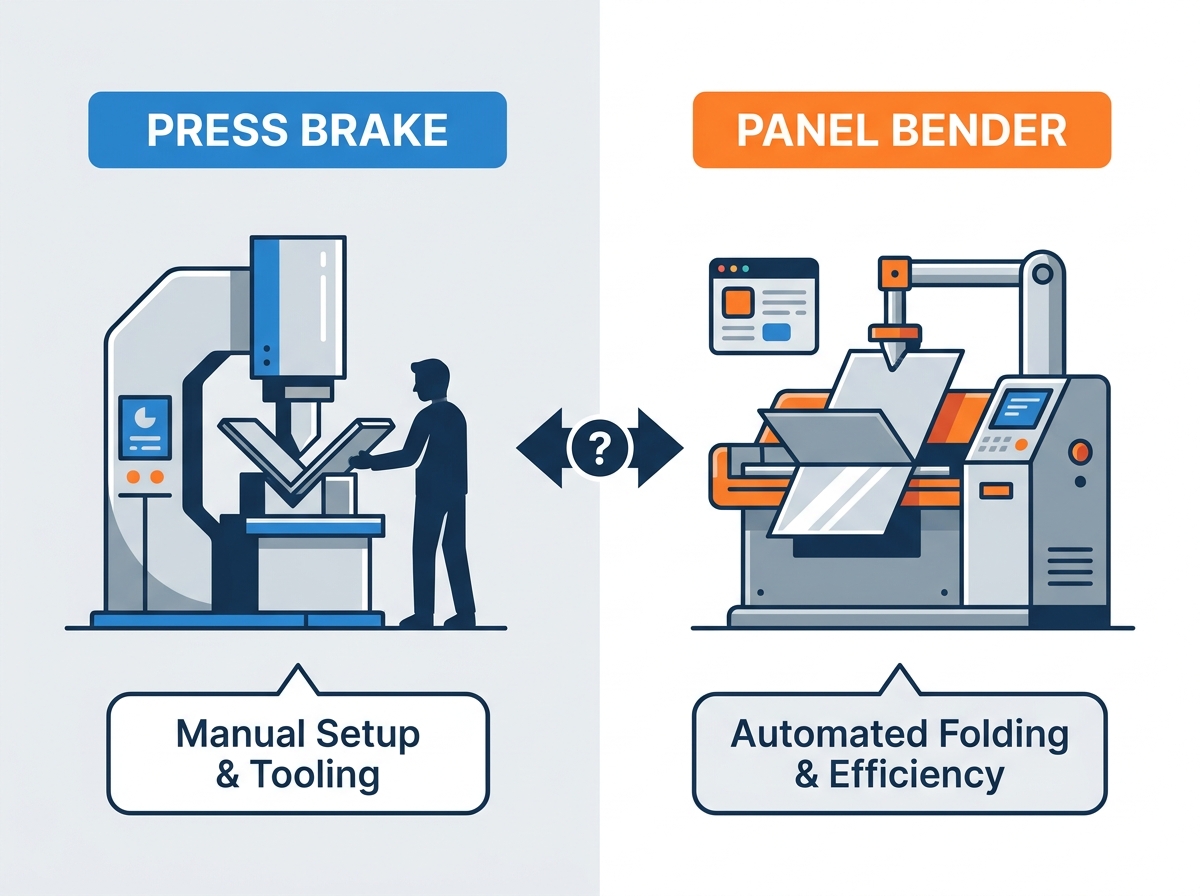
Analyzing the time required to complete a multi-bend part reveals stark contrasts between the two technologies. On a press brake, the cycle time includes the operator picking up the blank, aligning it against the backgauge, executing the bend, retracting the piece, flipping or rotating it, and repeating the process. If the part requires multiple tool sets, staged bending setups add further complexity and time. The press brake is inherently limited by operator fatigue, handling speeds, and manual dexterity. Wrestling a 4x8 sheet of 11-gauge steel all day slows down even the most veteran operator.
Panel bending equipment fundamentally alters the pacing dynamic. Because the machine handles all rotation and positioning internally, it dictates the cycle time. The operator simply loads the blank and unloads the finished part, ensuring automated, predictable throughput. During batch runs, eliminating manual inter-pass handling allows panel benders to achieve up to 2x to 3x faster cycle times on applicable geometries. For example, a standard six-bend electrical enclosure door might take 90 seconds on a press brake but only 30 seconds on an automated folder.
Press brakes excel in specific geometric applications where folding technology struggles. They remain the superior choice for narrow profiles, deep boxes, extreme acute angles, and heavy plate bending. Geometries requiring specialized, deep gooseneck punches to clear previously bent flanges are uniquely suited to the open architecture of a press brake. The ability to stack custom tooling allows fabricators to form complex, asymmetrical parts that would physically collide with the internal mechanisms of a folder.
Conversely, panel bending systems have strict physical limitations dictated by their clearance profiles. The size and shape of the blankholder and bending blades restrict internal bends, maximum flange heights, and minimum channel widths. If a box profile is too deep, the part will crash into the machine's upper tooling during rotation. Fabricators must carefully audit their part geometries to ensure they fall within the specific clearance envelope of the bending machine.
Modern panel bending systems utilize advanced, integrated real-time sensors to maintain precision. Technologies equivalent to Salvagnini's MAC2.0 measure actual sheet thickness and detect material tensile variations as the sheet enters the machine. The system then automatically compensates for springback on the fly, adjusting the over-bend angle dynamically. This results in highly consistent parts, even when material batches exhibit slight metallurgical inconsistencies.
Press brakes rely heavily on hydraulic or mechanical crowning systems and operator skill to maintain angle consistency, especially across long parts. Chasing degrees on a 10-foot bend requires experience. The physics of the bending process also differ significantly. The wiping action of a folding blade causes different material elongation compared to the high-force vertical friction of air bending in a V-die. Furthermore, the folding process is generally gentler on the material surface, reducing the scratching and die marks commonly associated with press brake operations. This proves highly beneficial for surface-sensitive materials like polished stainless steel or pre-painted aluminum.

The upfront costs associated with these machines represent a major divergence. Entry-level and even high-end CNC press brakes require a significantly lower initial capital investment compared to the premium acquisition cost of advanced panel bending systems. Press brakes offer an accessible entry point for fabrication shops looking to expand capabilities without massive financial exposure.
Calculating the return on investment requires analyzing machine uptime, setup time reduction, and cost-per-part amortization. In high-volume or highly repetitive production runs, the speed and automated setup of a panel bender drastically reduce the labor cost per part. The machine's ability to run continuously with minimal operator intervention accelerates the amortization of the higher CapEx, making it financially viable for specific production models. Conversely, in high-mix, low-volume environments, the press brake often remains the more economically sound choice.
The current skilled labor market presents significant challenges for fabrication shops. Finding, hiring, and retaining experienced press brake operators who deeply understand bend allowances, manual sequencing, and complex setups is difficult and costly. The press brake relies entirely on this human expertise to function accurately and efficiently. A highly skilled operator can make a press brake sing, but a novice can generate substantial scrap and bottleneck the entire shop.
Transitioning to panel bending shifts the labor paradigm. The requirement moves away from high-intensity manual manipulation and specialized physical bending skills toward offline programming, automated loading, and basic machine monitoring. Operators do not need to understand complex bend deductions or physically wrestle with heavy sheets. This allows shops to utilize less experienced personnel for machine operation while allocating their highly skilled programmers and engineers to optimize the software and production flow.
Physical floor space is a premium commodity in any manufacturing facility. While the footprint of the machines themselves can be comparable depending on the model, press brakes require extensive staging areas for Work in Progress (WIP) and massive tool storage cabinets for punches and dies. Panel bending systems, with their universal tooling and rapid throughput, often reduce the need for extensive WIP staging, streamlining the floor layout.
Long-term maintenance profiles also differ. Press brakes require hydraulic fluid management, regular calibration of crowning systems, and continuous replacement of mechanical tooling due to wear. Modern panel bending equipment often utilizes servo-electric drives, which eliminate hydraulic maintenance but introduce complex sensor suites and automated manipulator mechanisms that require specialized technical support.
Maintenance Category | CNC Press Brake | Automated Panel Bender |
|---|---|---|
Drive System | Hydraulic oil changes, valve checks | Servo-electric motor monitoring |
Tooling Wear | High friction wear on punches/dies | Low friction wear on wiping blades |
Calibration | Mechanical/Hydraulic crowning adjustments | Sensor suite and manipulator alignment |
Migrating parts from a press brake to a panel bender introduces a significant engineering and design bottleneck. Legacy flat blanks cannot simply be transferred directly to the new machine. The necessity of redesigning and re-engineering flat patterns is a major implementation reality. Engineering departments must invest time in updating CAD files and reprogramming parts to accommodate the new bending kinematics.
The physics of flat pattern adjustments dictate this requirement. K-factors and bend deductions must be recalibrated because material deformation characteristics differ fundamentally under wiping and folding kinematics versus traditional air bending. The material stretches differently, meaning a flat blank cut for a press brake will result in incorrect final dimensions if folded on a panel bender. Shops must account for this engineering learning curve when planning the transition.
Press brake operations involve hidden costs and complex storage logistics associated with extensive tooling libraries. Shops must maintain a vast array of punches, dies, specialized hemming tools, and surface-protection tapes to handle diverse geometries. Managing, organizing, and physically changing these tools consumes valuable production time and requires constant inventory tracking.
Panel bending systems offer a tool-less setup reality for the majority of standard profiles. The universal bending blades adapt automatically to different lengths and thicknesses. However, identifying the absolute limits of this universal tooling prevents unexpected downtime. While it handles standard flanges effortlessly, specific geometries like narrow channels or offset bends may still require auxiliary or customized tooling inserts. Understanding these limits prevents unexpected production halts when complex parts are introduced to the schedule.
Neither machine is universally superior; the optimal choice depends entirely on part geometry, production volume, and the specific labor constraints of the facility. Fabrication shops must align their equipment investments with their core manufacturing strategies. Shortlisting logic dictates choosing a press brake for high-mix/low-volume production, heavy plate bending, deep box geometries, and complex custom fabrication where flexibility is paramount. Conversely, panel bending systems are the clear choice for high-volume, highly repetitive, surface-sensitive, or large-panel production where manual handling is a severe bottleneck.
Nanjing Jinqiu CNC Machine Tool supports manufacturers with CNC machine tool solutions designed to improve sheet metal processing efficiency, accuracy, and production stability. The company can help customers evaluate suitable equipment configurations according to their materials, part geometries, production volumes, and automation requirements.
To move forward effectively, fabrication managers should execute the following next steps:
Audit your top 20 highest-volume parts for geometric compatibility with folding kinematics.
Calculate current press brake cycle times against simulated automated folding times provided by equipment manufacturers.
Evaluate your local labor market to determine the long-term viability of manual machine operation versus automated systems.
Consult an applications engineer to map out the flat-pattern redesign process and estimate engineering hours required for the transition.
A: Press brakes can handle extreme thicknesses, often exceeding 1-inch plate depending on the machine's tonnage. Panel bending machines are typically limited to thinner gauges, usually maxing out around 11-gauge (0.120") for stainless steel or 9-gauge (0.150") for mild steel, depending on the specific machine model and blade configuration.
A: No. While they drastically reduce the workload for standard panels and enclosures, press brakes remain necessary for heavy plate, narrow profiles, deep boxes, and geometries requiring specialized punch configurations that folding blades cannot physically accommodate.
A: Air bending on a press brake forces material into a V-die, creating concentrated friction and specific stretching. A panel bender wipes the flange upward or downward while holding the sheet flat, distributing the stress differently. This requires recalculating K-factors and bend deductions for accurate flat blanks.
A: No. A standard CNC folder requires the operator to manually position and rotate the part between bends. An industrial panel bender features fully automated grippers and rotators that manipulate the sheet without human intervention, resulting in significantly higher throughput.
A: The higher cost reflects the complex automation. They include integrated material manipulators, automated universal tooling that adjusts on the fly, advanced real-time material sensors, and sophisticated software required to control the automated part rotation and bending sequences simultaneously.
A: Yes. Because the material elongates differently under folding kinematics compared to V-die air bending, existing flat patterns will yield incorrect final dimensions. Engineering teams must recalculate bend allowances and update CAD files for the new equipment.


