Views: 0 Author: Site Editor Publish Time: 2026-07-20 Origin: Site


Sheet metal fabrication faces an escalating bottleneck: the heavy reliance on highly skilled operators to manage complex, multi-setup bending operations. Maintaining tight tolerances on complex part geometries while achieving high throughput creates constant tension, particularly in high-mix, low-volume manufacturing environments. Traditional manual forming often struggles to keep pace with these demands, leading fabricators to explore automated solutions. The shift from manual forming to automated panel bending represents a major operational upgrade for many shops. However, selecting the right equipment requires a strict evaluation of drive systems, clamping mechanisms, and automation levels, rather than simply relying on standard OEM spec sheets. Understanding these technical nuances ensures you invest in machinery that genuinely solves your production challenges without introducing new bottlenecks.
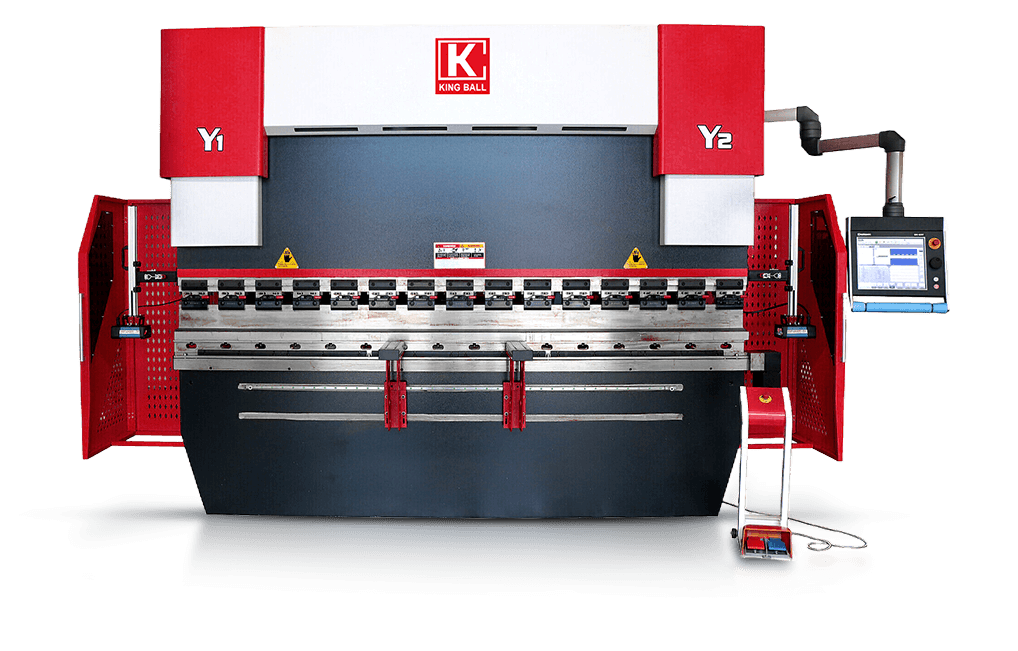
Automation vs. Flexibility: Fully automated panel bending machines drastically reduce cycle times for complex, multi-sided parts, but traditional press brake machines remain superior for ultra-thick materials and extreme custom geometries.
Drive System Impact: Servo-electric panel benders offer lower maintenance and higher energy efficiency, while hydraulic systems are necessary for high-tonnage applications.
Clamping Mechanisms Dictate Capabilities: The choice between suction cup and press arm manipulators directly determines the minimum part size, surface finish quality, and allowable flange heights.
Table of Contents
Panel benders utilize oscillating bending blades to fold material around a stationary counter-blade. This kinematic approach allows for rapid, multi-directional bending without repositioning the entire sheet. The material remains flat on the machine table, which completely eliminates the "whip-up" effect common when bending large panels on traditional equipment. In contrast, a Press Brake Machine relies on the linear descent of a punch into a die, forcing the material into a specific V-shape. The panel bender's oscillating action significantly reduces the physical manipulation required during the forming cycle, allowing for positive and negative bends to be executed in rapid succession.
When an operator forms a large enclosure door on a standard brake, they must physically support the weight of the material as it swings upward during the bend. This requires multiple operators or specialized sheet followers. Panel bending technology bypasses this issue entirely. The machine's manipulator advances and rotates the flat blank, while the upper and lower bending blades articulate to create the flanges. This fundamental difference in kinematics changes how parts must be designed and processed.
Understanding where Panel Bending Machines fit within the broader industrial landscape prevents costly procurement errors. They serve a highly specific function compared to other forming equipment found on the shop floor.
Sheet Folding Machines: Standard folding machines use a single folding beam to bend the material. They are generally slower and require more manual intervention. True panel benders feature multi-axis, fast-oscillating upper and lower blades, enabling far more complex geometries and faster cycle times.
Tube, Pipe, and Profile Benders: Panel benders are strictly designed for flat sheet metal fabrication. They cannot process structural profiles, angle iron, or tubing.
Roll Bending Machines: Roll benders create continuous, long-radius cylindrical forms like tanks or large pipes. Panel benders excel at precise, multi-angle flange forming on flat blanks, though they can perform step-bending for large radii.
Panel benders employ a "universal tooling" concept. The machine uses a standard set of upper and lower blades capable of executing various bend angles and radii. This eliminates the physical tool changeovers required in press brakes, where operators must swap punches and dies for different bend profiles, material thicknesses, or inside radii. The machine automatically adjusts the blade stroke and position via CNC control to achieve the desired angle.
This universal approach results in a massive reduction in setup time between jobs. In a high-mix environment, a brake operator might spend thirty minutes tearing down and setting up segmented tooling for a complex box build. A panel bender transitions from one part program to the next in seconds, as the only physical change is the automatic adjustment of the blankholder tool length to match the new part's dimensions.
Automated panel bending drastically reduces manual material handling. The machine manipulates the sheet automatically during the bending cycle. This removes the ergonomic strain and safety risks associated with manual operation, where operators must support and guide heavy or awkward parts through each bend. By removing the operator's hands from the forming area, shops see an immediate drop in fatigue-related errors and safety incidents.
Feature | Panel Bending Machine | Press Brake Machine |
|---|---|---|
Material Handling | Automated rotation and advancement | Manual support and positioning |
Tooling Setup | Universal blades, automatic adjustment | Manual punch and die changes |
Part Orientation | Remains flat on the table | Swings upward during the bend |
Cycle Time (Complex Parts) | Extremely fast, continuous operation | Slower, requires repositioning |
Servo-electric systems utilize AC servo motors paired with belt/pulley or ballscrew mechanisms to drive the bending blades and clamping systems. The complete absence of hydraulic oil eliminates thermal drift, resulting in higher bend angle repeatability over long shifts. As the machine runs, there is no fluid to heat up and change viscosity, meaning the first part of the day matches the last part of the day perfectly.
These machines are ideal for thin-to-medium gauge materials, such as HVAC components, lighting fixtures, or electrical enclosures, where precision, low energy consumption, and minimal maintenance are prioritized. Maintenance routines are simplified to greasing bearings and inspecting belts, rather than managing oil changes, filter replacements, and leak repairs.
Hydraulic models rely on hydraulic cylinders and proportional valves for blade actuation and clamping force. They generate massive, sustained tonnage required for bending thick plates or high-tensile materials like stainless steel and heavy-gauge aluminum. When a shop processes materials that demand high forming forces, hydraulics remain the standard.
However, they consume more energy, require regular oil maintenance, and may experience slight variations in precision due to hydraulic fluid temperature fluctuations. Shops running hydraulic systems often need to implement chillers to maintain consistent oil temperatures during heavy production runs, adding to the overall footprint and maintenance schedule.
Hybrid architectures combine servo-electric drives for the bending blades with hydraulic systems for the clamping mechanism. This provides the speed and precision of electric drives alongside the holding power of hydraulics. The electric blades move rapidly to execute the folds, while the hydraulic blankholder ensures the material does not slip during high-tonnage bends.
Hybrid systems offer a middle-ground solution for fabricators needing high throughput and the ability to process moderately thick materials without the full footprint of a pure hydraulic machine. They balance the need for speed with the necessity of rigid clamping.
Assess your primary material thickness and tensile strength to determine tonnage requirements.
Evaluate your facility's power capacity and energy consumption goals.
Review your maintenance team's capability to manage hydraulic systems versus electromechanical drives.
Analyze the required bend angle tolerance; tighter tolerances often favor servo-electric systems.

The method used to grip and move the sheet dictates the machine's capabilities. Suction cup systems use vacuum manipulation, allowing for the processing of smaller parts and preventing surface marring on sensitive materials like pre-painted aluminum or polished stainless steel. Because the vacuum pads grip the flat surface of the sheet, they do not interfere with the edges, allowing for very narrow flanges to be formed.
However, vacuum systems struggle with heavily perforated sheets or materials with heavy mill scale. Press arm systems use mechanical clamping arms, offering superior grip for heavy parts and perforated materials. The mechanical jaws physically bite onto the edge of the blank. While highly secure, they place constraints on minimum part size and internal flange clearances, as the jaws require physical space to operate without colliding with the bending blades.
Semi-automatic systems require manual loading of the blank and unloading of the finished part, while the machine handles the bending sequence. An operator places the flat sheet against the squaring pins, initiates the cycle, and removes the formed panel once complete. These are best for variable, lower-volume runs where part sizes change frequently.
Fully automated configurations integrate sheet loaders, automated guided vehicles, and robotic unloading. A gantry system or articulated robot picks raw blanks from a pallet, feeds the machine, and stacks the finished goods. Fully automated cells enable "lights-out" manufacturing but demand rigid standardization in part design and upstream cutting processes. If a blank is out of tolerance, the automated loader may fail to position it correctly, causing a machine crash.
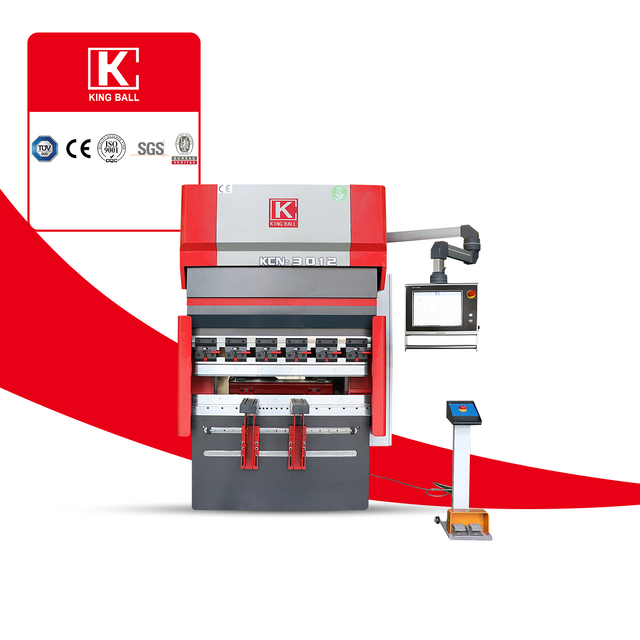
Choose a panel bender for positive/negative bends, hemming, radius bends, and multi-sided panels like doors, shelves, or cabinets. The ability to flip the bending direction instantly makes them perfect for Z-bends and complex edge profiles. They excel at forming large, flat panels with multiple edge flanges.
Choose a press brake machine for deep box forming, narrow profiles, extremely thick plates, and parts requiring specialized custom tooling, such as offset bends, louvering, or coining. A panel bender cannot form a deep, narrow channel because the manipulator and blankholder require a minimum flat area to grip the part. Press brakes, with their vast array of gooseneck punches and specialized dies, handle these extreme geometries easily.
Panel benders excel in high-mix, low-volume environments due to zero-setup tooling, allowing batch sizes of one to remain profitable. When comparing cycle times for a 4-sided panel, a panel bender often completes the part in seconds. The manipulator rotates the part 90 degrees instantly between edge bends.
A press brake requires significantly more floor-to-floor time due to the operator's handling and repositioning requirements. The operator must bend one side, remove the part, rotate it manually, align it against the backgauge, and initiate the next bend. For a large panel, this manual handling accounts for the majority of the cycle time.
Acknowledge the significantly higher initial capital expenditure of panel bending technology. These machines represent a major investment in automation. However, operating expenditures often favor the panel bender over time. Contrast the tooling inventory costs: a press brake requires racks of expensive punches and dies, while a panel bender uses its universal set.
Energy consumption is generally lower on servo-electric panel benders compared to large hydraulic brakes running continuously. Labor rates also shift; instead of requiring a highly experienced metalworker to manually form complex parts, a shop can utilize a machine tender to load blanks and monitor the automated cycle.
Application Type | Recommended Equipment | Reasoning |
|---|---|---|
Large Enclosure Doors | Panel Bender | Eliminates whip-up, fast multi-sided bending |
Thick Plate Brackets (1/2") | Press Brake | Requires high concentrated tonnage |
Deep Narrow Channels | Press Brake | Panel bender manipulator cannot grip narrow profiles |
High-Mix Thin Gauge Panels | Panel Bender | Zero setup time between different part geometries |
Disconnects between engineering models and machine control software pose a significant risk. If the engineering department designs parts with bend radii that the machine cannot execute, production halts. Evaluate offline programming capabilities, 3D simulation accuracy, and compatibility with existing manufacturing execution systems.
Emphasize the need for software that automatically calculates bend allowances and performs collision detection. The software must unfold the 3D model, apply the correct K-factor for the specific machine, and simulate the bending sequence to ensure the part will not collide with the machine frame or tooling during the cycle.
Panel benders require highly accurate blank sizes. Variations in laser cutting or punching directly translate to dimensional errors in the final bent part. Because the machine references the outer edges of the blank to position the bends, a blank that is cut 1mm too long will result in a flange that is 1mm too long.
Establish strict tolerance controls on upstream profiling machines before integrating a panel bender to ensure consistent quality. Regular calibration of laser cutting machines and turret punch presses is mandatory. If your blanking process is sloppy, the automated bending process will only amplify those errors.
Shifting from manual forming to automated bending changes the required skill set from tactile metalworking to CNC programming and system troubleshooting. The operator no longer feels the metal yield; they monitor sensors, alarms, and robotic movements.
Budget for comprehensive OEM training and prioritize intuitive, visually guided human-machine interface systems during the procurement process. Operators need to understand how to recover from a machine fault, how to adjust parameters for material batch variations, and how to perform routine electromechanical maintenance.
Selecting the right panel bending machine requires more than comparing tonnage, bending speed, or standard equipment specifications. Manufacturers should evaluate part geometry, material thickness, production volume, drive systems, clamping methods, upstream cutting accuracy, software compatibility, and the required level of automation.
Nanjing Jinqiu CNC Machine Tool provides CNC sheet metal processing equipment and technical solutions for manufacturers seeking greater bending accuracy, production efficiency, and automation. Its industry experience can help customers evaluate equipment configurations according to their specific materials, part designs, and production requirements.
Before investing in a panel bending system:
Conduct a time-study audit of your current top 20 highest-volume parts to identify manual handling bottlenecks.
Calculate current setup times across your existing bending operations to quantify lost production hours.
Request cycle-time simulations from equipment manufacturers based on your specific CAD files to verify throughput claims.
Evaluate your upstream cutting tolerances to ensure compatibility with automated bending edge-referencing systems.
Assess your facility's floor space and power availability to accommodate automated loading and unloading cells.
A: Maximum thickness varies by machine and material type. Servo-electric models typically handle up to 3mm (11 gauge) mild steel, while heavy-duty hydraulic models can process up to 4mm or 5mm mild steel. Always consult the manufacturer's specifications for specific material grades.
A: Panel benders excel in small batch production due to their universal tooling. They require zero physical tool changes between different bend angles or profiles, making batch sizes of one highly efficient compared to the manual setup required on a press brake.
A: Suction cup benders use vacuum pads to hold the sheet, ideal for delicate surfaces and small parts but poor for perforated metal. Press arm benders use mechanical clamps, providing strong grip for heavy or perforated sheets but limiting minimum part size.
A: Yes, panel benders are highly capable of forming hems and large radius bends through a process called step bending or bumping, utilizing their standard universal tooling without requiring specialized dies.
A: No. Panel benders use a universal set of upper and lower bending blades. The machine adjusts the blade stroke and angle dynamically via CNC programming to achieve various bend angles, eliminating the need for dedicated punches and dies.
A: Panel benders reference the outer edges of the blank for positioning. If the laser-cut blank is dimensionally inaccurate, those errors will compound during the bending process, resulting in out-of-tolerance final parts.
A: No. Panel bending machines are designed exclusively for flat sheet metal fabrication. Tube and pipe bending require entirely different machinery designed to support cylindrical or structural profiles during the forming process.


